
In a paper published in Ecology in 2001, Sonia Sultan examined the relationship between ecological breadth of species and phenotypic plasticity for different fitness components. Through a set of greenhouse experiments on congeneric species of the annual plant Polygonum, in which light, water and nutrient levels were varied in different combinations, Sultan found strong and interactive effects of all three environmental factors on different fitness components. These results suggested that ecological breadth of a species reflected an ability to both maintain fitness in poor environments and take the opportunity to capitalise when the environment is favourable. Twenty-four years after the paper was published, I spoke with Sonia Sultan about the origins of here interest in this topic, her memories of the making of this study, and her view today on the paper’s findings and interpretations.
Citation: Sultan, S. E. (2001). Phenotypic plasticity for fitness components in Polygonum species of contrasting ecological breadth. Ecology, 82(2), 328-343.
Interview conducted online on 14 March 2025; Sonia Sultan was in Boston, USA and Hari Sridhar in Klosterneuburg, Austria.
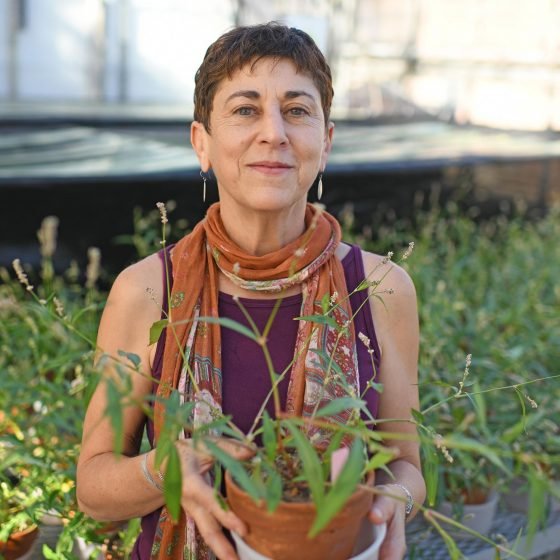
Sonia Sultan with Polygonum plants in the research greenhouse, Wesleyan University, 2019 (© Olivia Drake, Wesleyan University).
Hari Sridhar: I’d like to start by asking you to talk a little bit about the motivation for this particular piece of work, in relation to what you had already done on the system till that point in time. Also, please tell us about how you got interested in phenotypic plasticity and working on this system, which goes back much longer this study.
Sonia Sultan: I became interested in plasticity because, as a graduate student, I found the Modern Synthesis explanation for evolution rather abstract and also incomplete. I had not studied biology intensively as an undergraduate, so I came to my graduate work a bit less schooled—less trained—in the conventional wisdom. I was interested, in particular, in the role of genes, and whether we had properly understood adaptation by describing it as a process of genetic sorting. One reason for my scepticism was that when I simply observed plants growing in the world, it was obvious that their phenotypes—their bodies—varied a lot depending on the conditions in which they were developing. The idea that phenotypic differences are genetically dictated simply didn’t accommodate the completely obvious fact that development is different in different conditions. And I thought, why are we turning away from this? Why are we ignoring this obvious fact about organisms? And then, I went on my very first field trip. At the time, I was working with a distinguished systematist of ferns, and he, very kindly, got me on a field trip to the Andes to collect fern species. And he explained to me that the leaf undersides of one species would be white, and those of this other species would be yellow; presumably reflecting some kind of adaptive species differentiation. And yet, when I went into the field, I could see those two different colours of leaves sometimes occurred on the same individual. And I thought, well, if major phenotypic differences don’t sort out by species, then we may need to separate the process of genetic differentiation—for example, species differentiation—from the process of adaptation to the conditions the individual is adjusting to right now. So, I started to think about adaptation as a more active process, which is the idea that an individual adjusts its phenotype in response to its developmental conditions.
That was a very unconventional idea at that time, although early on, as I was exploring this in my second year of graduate school, I found a 1965 paper about phenotypic plasticity by a British botanist named Anthony Bradshaw that had been pretty much ignored. On the one hand, I was very disappointed that someone else had had this brilliant idea before me, and on the other hand, I was very reassured that I was onto something that was worth looking at—that it was real. So, I did my PhD work on something rather unusual, which was to try to understand how one genotype can be differently expressed in different conditions. And the person who guided me was Richard Lewontin, who was very interested in this for the same reason really: to try to understand whether our way of thinking about the genetic basis of adaptation was an oversimplification and a distortion, which my thesis work showed it was.
This 2001 paper was based on the first grant project I wrote, as a postdoc. I was very fortunate to have an independent postdoc at the Center for Population biology at UC Davis, which was new at the time. I was in the first generation of postdocs there, which included Jonathan Losos and Bill Morris, and we were given the freedom to develop our own research programs, which is very unusual, of course, for a postdoc. And we were given Principal Investigator status, which meant we could submit NSF grants. So, I wrote this grant, which was sort of taking my PhD work further—instead of just looking at what an individual genotype can do, the grant asked the question: what is the relationship between individual plasticity–the capacity to respond to the environment–and the ecological distribution of species? In other words, how much of an ecological impact does this individual capacity have? Evolutionary biologists up to then had imagined that generalist species might consist of a kind of a mosaic of locally adapted ecotypes because the process of evolution, as we had conceptualized it in the 20th century, was all about increasing genetic specialization: the sorting of genes to be right for a particular kind of condition that happens in one population or one microsite. So, we kind of envisioned the process as a continual genetic sorting. On the other hand, if the process of evolution produces genotypes that are developmental systems, that can respond to different environmental states that occur within a location, then what evolves is the capacity for plasticity. And then, what we would see is that species that exist in a lot of different habitat types are the ones where the individuals have more of this capacity. It’s a completely different conceptual model of how a species can occupy different habitats. I wanted to look at that, and that’s what the grant was: to try to characterize individual plasticity for a set of closely related species with different ecological distributions. The grant wasn’t just for fitness traits, but of course it included fitness traits. I got the grant just as I was finishing my postdoc. The first empirical papers that came out of my own lab were on this grant, including this study.
That was the main structure of the project, but the other part of the project that I worked on was to look carefully at fitness and how we measure it. That was part of just trying to think more deeply about what we mean by adaptation. At that time, it was very typical to have a single measurement of fitness. I mean, it still is, in many studies, to measure something like total reproductive output, either in numbers or in grams, and to think no more about it. I wanted to take that further, because I was thinking more about the organism and how we interpret it. We divide the organism into what we think of as individual traits, and then we measure those traits as separate aspects of the phenotype. But, of course, the phenotype is an integrated whole. So, that habit of trying to deconstruct it into separate traits is always going to limit our understanding. And then, we go further, and have this really odd idea of selection on individual traits, which, of course, can’t really happen. I just was very interested in our way of thinking about adaptation, in our way of thinking about fitness, our way of understanding how traits interact with each other, our way of measuring those traits and of measuring fitness. I was kind of intellectually dissatisfied with a lot of the approaches that I had learned as a student. That’s a very odd place for a paper to come from, especially for someone so young. I can’t really explain why I was so rebellious and maybe so overconfident or arrogant or something, as to think that I could contribute something to those ideas that so many people had thought about before me, but that was who I was. I think part of it is because I came to my work from outside biology. My undergraduate training was in history and philosophy of science. So, I started out with a kind of a critical perspective, which, in itself, is a little unusual, at least for scientists trained in North America.
HS: Before I ask you more about the paper, I want to step back a little bit and ask you about that switch from history and philosophy to biology. How did that happen? And, from what you were just saying, it seems like, even before you started biology, you had an interest in plants. Where did that come from?
SS: I come from a family of non-scientists. My father was a professor of literature and my mother was a psychologist. As a high school student, I was interested in things like literature and history and not at all interested in science, because the way science is taught, or was taught in high school, was basically as a set of facts to be memorized. What is less interesting than that? To give a student a textbook and say, “Here, learn this. Learn it and put it on the test. This is the reality.” I hated that. And because that just seemed like a waste of time to me, I didn’t want to take any science courses in high school. But, of course, I wanted to go to university, and the guidance counsellor (the person who counsels students on their way to University) said to me, you must take science if you want to get into a good university. So, I thought, okay, if I have to do it, I’ll take this plant course, which was forestry. Forestry was a class for people who were going to work managing forests in the government Forest Service. There were five people in the class, one of whom was from a family that had a tree farm business. And, of course, they were all young men, because this was a class for people who were going into this kind of work, which, at that time, would not have been open to a woman. And, in fact, a park ranger visited the class one day to talk to us about the possible careers, and I told him, “I’m very interested in being a forester.” He said, “Well, you can’t be a forester.” Because I was a woman. He said, “You might be able to work for the Forest Service taking tickets or something, but you’re not going to be working in the forest.” That was a rude awakening. But in any case, I took this course because it seemed very easy and it wasn’t really about textbooks. The course consisted of two things. Part of the course was going with this wonderful teacher who taught this course—Mr. Fox—in his van to look at trees and forests and to learn about them in the field. And the other part of the course was working in this tiny greenhouse and growing plants. I just fell in love with the whole thing. It was just wonderful. It wasn’t science as science was taught then in the 1970s. It was about living organisms. Science at that time was ultra-reductionistic, as it still is, in many ways. But what students would have been learning at that level in high school was just the most simplified, ultra-reductionist views, as is still mostly true for genetics. So anyway, that’s what got me into plants. And then, I graduated from high school early in order to take an internship at a wonderful plant institute in Boston, which is where I grew up. Harvard University runs something called the Arnold Arboretum, which has a very famous and important living collection of woody plants. I had the good fortune to be taken on as an intern at the Arboretum. I got to work with the propagator, I got to work mapping the trees on the grounds and learning their histories, I got to work in the botanical library, I got to work with the taxonomist on herbarium specimens. So, I got all these different kinds of exposure to how people studied plants. And I thought, this is for me. I had a certain sense that I was drawn to plants as organisms and learning about them and being around them, but I was not drawn to the reductionist scientific approaches at the time.
That’s how I started. As a result, when I went to university, I thought, well, I need to take a bio major (which is the same as what pre-medical students did) so that I can go on to study plants. I did the biology major for one week. I had my big stack of textbooks—calculus, chemistry and the whole thing—and I thought, this is terrible. All my friends were studying, you know, politics and reading Brecht and poetry and all kinds of interesting things, and I was memorizing stuff. I thought, I’m not doing this. So, I traded it in, and the sort of adjacent major was history of science. And, because it was Princeton, and that’s where Thomas Kuhn did his work on Scientific Revolutions, there was a very strong history and philosophy of science major program. As a student in that program you could take a few courses in biology or other sciences, and then study history of science in seminars and do original library research. I did that. And of course, what you learn when you study the history of science is that people invent science, and they invent it in different ways, at different historical and cultural moments. You also learn that science is not a brick wall of facts. It’s a human endeavour full of all the glitches and limitations that characterize human endeavours. So, the scientific approaches at the time didn’t seem inevitable to me. They seemed like, well, you could take that approach, or you could make a different approach. And so, I think I had an advantage having that training in the history of science, and seeing that people’s ideas about science change all the time, just as their ideas about everything change all the time
HS: How did you then come back to science?
SS: Good question. When I graduated in history and philosophy of science, I had to make a choice. I was very bookish, so I knew I was headed for an academic life. I knew this was a very good place for me. But I realized I had to make a choice between going on as a historian of science, which would have been quite natural for me, and I would have been good at it because I like to write, or doing the thing I had wanted to do since Mr Fox’s high school class, which was to study plants, which was much harder. One big factor for me was this: as a history of science student, I had the opportunity to be in seminars with graduate students going on in the field, and what I did not like is that as a historian of science you could say anything; there was very little constraining your interpretation. I mean, there are historical documents, but you can interpret them in such a broad range of ways. And I didn’t like that. It seemed like there was a lot of, sort of, playing around with ideas and developing jargon and ego. What I love about biology is you have to be faithful to what is happening in front of you. You have to be faithful to the observations and the results of an experiment. That’s your discipline, that you follow the organism. You don’t say, “I think this”. You say, “I see the organism doing this and therefore I think this.” I really liked that discipline. It seemed more humble and less arrogant. Humans are very arrogant. I like having to say “I must follow the organism. I don’t tell the organism what it does”. So, just intellectually, it seemed more honest. That’s how I decided to do the science thing, which was really difficult because, at that point, I had to start at the beginning, and I had no confidence that I would have the ability to do it. I had so much to learn. But I made that choice to try to learn how to study plants and how to think about them, in a way that would respect them. Because one thing I really disliked about science at that time, which is still there, was its sort of Baconian flavour, you know: we will tear nature’s secrets from her. Or, we will wrestle her into this test tube and make her do what we want—an attitude, of course, it still has. There’s something very disrespectful, for sure, about that, and it’s sort of about power in a way, and manipulation. It’s not the kind of relationship with nature that, well, would actually serve us, as we can see. But also, I don’t feel right about it. We are animals, right? So, we should find ways to be connected to other living things. Not imagine that we are above them or that we own them. There’s all kinds of stuff in there—all kinds of attitudes about the world.
HS: You mentioned that Richard Lewontin was involved in your PhD work. Reading your profile, I also came across the name of Fakhri Bazzaz. Was he also a supervisor?
SS: Yes. I was very fortunate to work with these two extraordinary scientists. Dick Lewontin was the person who really helped me see that studying the norm of reaction approach was an alternative to genetic determinism. He had me read Schmalhausen’s 1941 book (published in English translation in 1949) to learn about the norm of reaction, just as his PhD advisor Dobzhansky had instructed him to do. And Lewontin was a follower, really, of Sewall Wright, who was talking about plasticity in 1931. So, I was schooled in all of these aspects of population genetics that would open that door to an alternative perspective. And when I was first starting at Harvard as a graduate student, a new professor joined the faculty, and this was Fakhri Bazzaz, who was a very distinguished plant ecologist from University of Illinois. Fakhri came and Harvard built for him a beautiful experimental greenhouse, which they destroyed as soon as he retired! Fakhri took me into his lab despite my lack of research experience, and, from him, I learned how to study plants. He was a very unusual scientist—very forward thinking. For example, he was studying the effects of elevated CO2 in the 1980s, and he actually testified in front of Congress at that time about what those effects could be like and how destabilizing they would be for natural communities. This was at a time when everyone else was talking about increased atmospheric CO2 as free fertilizer—”Oh, plants will grow more; it’s free fertilizer.” And Fakhri was like, well, it’s not going to work like that; it’s not that simple. He was also an exceptional man, a really illuminated individual, someone who could quote poetry, a very kind mentor and a wonderful person. I was very lucky to work with him. He was also the kind of lab head who walked through every one of his students’ experiments every morning, which was completely unheard of at Harvard. I had a friend at Harvard whose advisor met with her once a year during her PhD! Every day, Fakhri walked through my experiments, looking at my greenhouse benches and those of the other students in his lab—there were eight of us or whatever—because he knew, and he taught me, that nothing matters if the data is bad. The only thing that matters is to do the experiment in such a way that you learn something real, that your results are not distorted by the simplifications and sloppiness and mistakes that people make in their experiments. He taught us that experiments have to be really good, really well-designed, really beautifully carried out. You have got to do really, really careful, beautiful work in your experiment, because that’s what gives you information that means something. If the work is solid, you can trust the results even if they are not what you expected. It was a huge advantage, to learn from someone like that. So, I did very, very careful experiments that were built around ideas that I developed with Dick Lewontin, and that was a very fortunate combination of the application side and the conceptual side.
HS: How did you choose to work on Polygonum? Was it a system that was already being worked on in your lab?
SS: No, actually this choice came about in a kind of an odd way for a graduate student. I first thought, “Well, before I know what research I want to do for my PhD, I need to develop some ideas about this plasticity thing: what can I find out about it?” So the first thing I did was I wrote a long review paper, which is a really odd thing for a starting- out graduate student to do. So I wrote this paper, and from the paper and other reading I decided I wanted to do a series of norm-of-reaction experiments. This meant developing a set of genotypes that could be cloned, so that I could do very clean experiments using genetic replicates that I could put in different environments to study functionally important aspects of plasticity in response to those environments. Fakhri was a physiological ecologist, so he knew all about studying plant function and the functional morphology of the phenotype, and I learned all of that from working with him, which was fantastic. So, I could really talk about adaptation—not just measure reproductive output, but talk about how the body of the plant was adapting. With this plan in mind, I made a list of the attributes I needed for a study system for my work. For example, it had to be an annual so I could measure total lifetime reproductive output, but I also had to be able to clone it so I could do these clean norm-of-reaction experiments with genotypic replicates. It had to be something that occurred in a lot of different habitats, because that indicated a species that would likely have plasticity, rather than something that was narrowly limited to one habitat. And it had to be readily available to me in New England and not rare or hard to find. The species had to be morphologically simple enough that I could do a lot of work, measuring the phenotypes of hundreds and hundreds of plants. For example, I wanted a plant with simple leaves rather than complex doubly or triply compound leaves in which it would be very difficult to study leaf area and thickness, which are key functional traits. To measure fitness, ideally, the species would have dry rather than fleshy fruits, so that I could have a simple way to measure fitness and not have to separately look at fruit mass and seed mass. So there was a list of about, I don’t know, six or eight criteria because I wanted a system that would help me look carefully at plasticity. So, I had these criteria, and I went into the herbarium and looked at many common and broadly distributed annual species. I looked at, I don’t know, five or six genera that had widespread species that were annuals, for instance Brassica. And I did a bunch of field work, and I looked at what was out there, and there were a number of really nice possibilities. The thing about the Polygonum system was that, unlike almost every annual, it can be cloned. The annual species in Polygonum can be propagated by cuttings, and that’s unusual for an annual. That’s why a lot of plasticity work that is done with perennials has this built-in flaw that the tissue comes from field conditions rather than being produced as a new generation under known, controlled conditions in the lab. You can’t do anything about that. Plus, measuring fitness in a perennial is a giant headache, because along with the season’s reproductive output there’s also the resources the plant is putting away for later growth and reproduction So, is that considered part of fitness, or does it take away from fitness, and how can you measure it? I mean, it’s a mess. I didn’t want any part of that. So, I found this system that had the broad distribution and so on, and was an annual which I could clone by making cuttings. And, ultimately, that was the decisive factor.

HS: Did you do all the work for this study after you moved to Wesleyan?
SS: Yes. I wrote the grant, I think, in the second year of my postdoc, and I started the experiments for it when I started at Wesleyan. The first step in the grant was a whole bunch of field work, which I did during the first summer after I took my position at Wesleyan, to develop the field populations that would be the basis of all of the subsequent work. There was a lot of driving around with two wonderful summer undergrads, one of whom is quite a renowned ecologist now—Berry Brosi at University of Washington. We learned how to scout four different Polygonum species from a car moving at 85 kilometres an hour! And we found about 80 populations, from which we chose subsets of populations that represented the breadth of habitats each of the species occupied. We did a whole bunch of environmental measurements. So, we developed this field system, which was the basis of, really, everything I did for about 15 years. Because the populations were the source of the material, but also the environmental context for interpreting the material—understanding what the selective conditions were in those populations. That was the first step. The second step was doing the greenhouse norm-of-reaction experiments. The first set of experiments were done in 1995. And what happened in ’95 was that it turned out to be the hottest summer in about 45 years in New England! It got so hot in the greenhouse that all the plants dropped their achenes. The greenhouse I’d used at Harvard was climate controlled, actually air conditioned and hugely expensive to run, and I was surprised they would do that. But also, it was a really aberrant season at the time because of this heat. I went into the greenhouse one day, and the floor was covered with the achenes—you know, the little one-seeded fruits. And I was like: there goes our fitness data! So, having done this enormous experiment with 1200 plants we had carefully nurtured and measured, we got some data from those plants, but not fitness data. We had to repeat the experiment the next year. So, the data in this paper is from 1996.
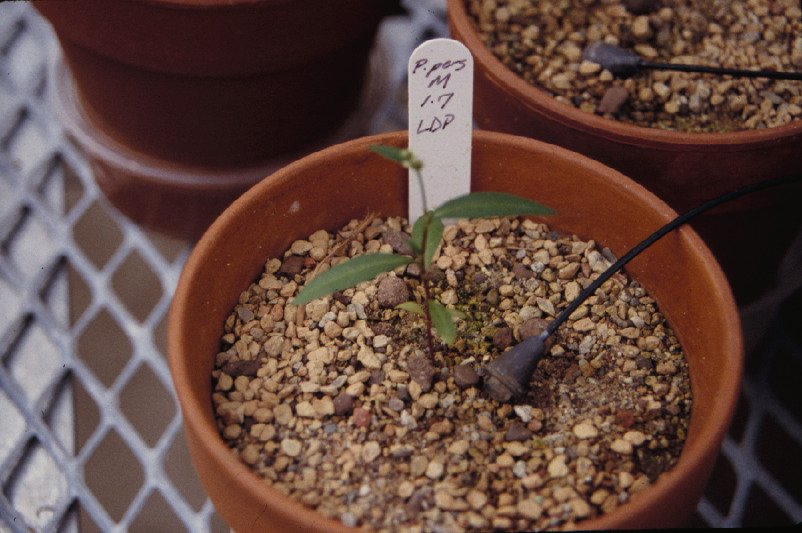
A Polygonum persicaria plant growing in the [Low light/Dry/Poor Soil] experimental treatment. Plants in the Dry treatment received water from a single watering tube (© S.E. Sultan).
SS: Of course, as you probably know, when you repeat an experiment, it gets much better. You fix a lot of things. The second time was smaller—it wasn’t 1200 plants—but it was very, very good. It was run by a young woman who was my predoc, who’s a professor now too—Amity Wilczek. I used to hire predocs—research assistants who had finished their undergraduate training and were planning to go on to a PhD, but wanted more research experience first. I liked mentoring people at that stage, and it sort of helped guide where they went after that. And also, because they’re not job hunting like postdocs, they are very focused on the work. Amity was my predoc for two years.
HS: Was this also because you couldn’t take PhD students at this stage?
SS: No, it wasn’t because of that. Wesleyan has a PhD program. You know, it’s a small place. I have always been the only person studying plants in my department, which is about 12 faculty. It was a challenge to get good PhD students until I became more well-known. But I’ve had very few PhD students. I’ve ad predocs, and I’ve had a lot of Master’s students, because Wesleyan has a 5-year program where very good research undergrads are invited to stay for a fifth year and earn a Master’s degree in addition to their undergraduate BA degree. I’ve had a lot of very good students from that program. I’ve also had some great postdocs. But I’ve had only, I don’t know, five or six PhD students.
HS: The other thing I was curious about is that the soil analysis for the study was done in a lab at the University of Massachusetts. I was wondering what the story behind that was.
SS: In the US, there are extension programs that are meant to serve farmers. They do soil analysis to tell farmers, or even gardeners, the nutrient content of their soil and what kind of enhancements it needs. And they will also analyse pests, if there’s problems with a pathogen or insect pest. I was able to take advantage of that resource—which was very inexpensive—to have the soils at these 20 different field sites analysed. That was part of putting together a kind of an environmental profile of all of the different field sites. There ended up being four species with five populations per species.
HS: Did you choose to do it at that lab because it was the nearest one, or did you know someone at that university?
SS: There were two labs near where I was: the Connecticut one and the Massachusetts one. I don’t think the Connecticut one did a detailed analysis. The Massachusetts lab happened to do a really good soil analysis, and it was only $7 a sample, And, they told me everything. Every micro- and macronutrient, any kind of contaminant, the cation exchange capacity—it was all in there. That was a great way to learn about those field soil conditions, without doing anything but sending them a little money
HS: I want to now go over the names of the people you acknowledge, to get a sense of who these individuals were and how they contributed to the study.
SS: Amity [Wilczek] was an excellent predoc, who I have already spoken about. Staci [Markos] was a wonderful University of California student. While she was an undergraduate at U.C. Davis, she assisted me in my postdoc work at the Center for Population biology there. And then, when I started my faculty position at Wesleyan, Staci came with me to help me set up my lab. She went on to work for many years as, I think, the director of the Jepson Herbarium at Berkeley. And then, the next three people—Geoff, Daniella and Julia—were undergraduates in the lab. Daniela went on to get a Master’s degree with me and a PhD at University of Virginia. Her MA work study was a really nice experiment testing dynamic root system plasticity in response to changes in soil moisture. Daniela was great. She did a postdoc with Lynda Delph but then changed careers. Ionel Mitrica was a terrific postdoc from Romania who was studying bacterial diversification in another lab at Wesleyan. I was inbreeding plants for the inbred lines that I used later and Ionel took care of the plants over a winter break, while I was away. Yeah, greenhouse and plant processing assistance, as i’ve said in the paper. Fred Adler was a postdoc at Davis; a very inventive theoretician. He came up with a population model for plants in which he modelled the plants as spheres! But anyway, a very, very lovely guy—very brainy , a very good theoretician and a generous colleague. I wanted to come up with a composite performance index that could summarize fitness when fitness is expressed differently in in a set of environments. Fred came up with this thing—”Adler’s F”. Fred Cohan is a colleague at Wesley and a bacterial evolutionist. As my senior colleague, he read a draft of the paper. Carl Schlichting was a colleague at U Conn. In 1987, when I was a graduate student, two papers were published about plasticity. One was my review, and the other was a review by Carl Schlichting and his PhD advisor., I think that was Don Levin, at the University of Texas. So, Carl was also a person who studied plant plasticity, and he later went on to become Massimo Pigliucci‘s mentor. They published a book together on phenotypic evolution
HS: Finally, you thank James Coleman.
SS: So, not surprisingly, Carl was asked to be a reviewer on the paper. There were so few people then studying plasticity that we were always reviewing each other’s papers. James Coleman was the editor for Ecology who handled the paper. Shall I tell you the story of the publication of this paper? is that something you want to know?
HS: Yes, please.
SS: Okay. The original paper was about how we think about fitness and how we study fitness, and therefore the appropriate place to publish it was the journal Evolution, which is where I sent it first. At Evolution, I don’t think they knew what to do with it. The editor it was sent to—to handle—was a theoretician, and he considered the paper too complicated. His words, not mine: too complicated. I mean, there was absolutely nothing wrong with the experiments or the analysis. They’re completely impeccable, none of the reviewers found anything wrong with them. But they didn’t like the paper. As Mike Wade would say, the results were not welcome! Because they kind of raised questions about how everybody was studying evolution. Like: well, we measure each genotype’s fitness, and then we move on. But in the paper I was saying that fitness is not one thing, and it’s not an attribute of a genotype since it varies in different conditions. You have to think about how one trait will change more than another trait, and there are different aspects of fitness. The approach that this paper takes does not help to implement a Modern Synthesis framework for studying evolution, where you want to assign a fitness value to a genotype. It doesn’t help with that. So, Evolution rejected it.
HS: Was it reviewed at Evolution?
SS: Yes, but they rejected it. I was very surprised, because I had always held Evolution in great regard. I was very surprised at the way they handled this paper, which was, I thought, completely unjustified. It seemed to me, as a young scientist, that the people who read Evolution should want to be doing this. They should want to be thinking more carefully about how to study fitness. That’s exactly how you move a field forward, by thinking in new ways about something fundamental. Anyway, I was —what’s the word for this—exasperated. And I thought, well, I have this really great data set, and it talks about really important things. Where should I send it next? Jim Coleman had been a postdoc in my graduate lab at Harvard. I think I saw that he was the editor at Ecology at that time and decided to send it there. Because he knew me, and I knew he would be open to something that…I mean, it’s not that he would favour something that I did, but he knew I wasn’t crazy. He knew I was somebody who did careful work. So, I sent it to Ecology, and he recognized that this paper has a lot to say about ecological distribution. That’s part of the point. So, he asked me to include Table 1, which was a set of predictions, e.g., what plasticity patterns would you expect based on the distribution of the species? I myself don’t think that way, but I made the table he asked for, and I had to revise the way the paper was framed to make it more appropriate for Ecology. It had to be more about ecological distribution and less about fitness. Which was okay. And then, the reviewers liked it, and it was fine. I mean, it was not a struggle. I made those changes; I mean the changes that Coleman requested about that table. That was after he got the reviews.
It’s interesting, and I now understand this better: ecologists were much more open to thinking about plasticity because, of course, they observe plasticity all the time in the field. And I think they were genuinely interested to think about how plasticity can influence species distribution. I think it’s very interesting how the complexity of the differences between the species could allow for them to coexist. Because one feature of these locations where you find annual Polygonums is that you find more than one species. And of course, that’s not supposed to happen if you’re, you know, Richard Levins, like, Oh, that can’t happen. There are functional trade-offs, species can’t succeed in multiple habitats, and species cannot coexist in the same niche. Well, it does happen, and it happens all the time. So, why is that? If these species are different from each other, and if they’ve evolved under selection to be different from each other in adaptive ways, why do they cohabit in the same place? Well, the reason is because the conditions that elicit plasticity are things like variation in light intensity and quality, and variation in moisture availability, and variation in spatial distribution of nutrient patches in the soil. And that stuff moves around all the time, in space and in time, within the life of an individual plant, and then from one season to the next. So, because the environmental parameters are always shifting, you don’t get this kind of targeted “one species wins and the other species loses” when they cohabit. There’s always this kind of, this one does better over here, and this one does better over here today, and this one does better over here two weeks from now. And they all stay in the mix. It’s the variation that lets them stay in the mix. And that point had been made at the level of genetic variation by people like Michael Turelli, but it had not been made as a way of understanding maintenance of species variation within a community. So, to me, that’s actually one of the most important insights from this work. Because, of course, what you see in the real world is not equilibrium. What you see is the constant shifting around, and the fact that there’s tremendous genetic diversity within populations as well as species diversity within communities. There’s not a genetic winner and a genetic loser, unless there’s some giant knockout mutation. Instead, diversity is maintained, and the thing that maintains it is the fact that different genetic individuals and different species have different strengths and weaknesses, and the environments in which those strengths and weaknesses are expressed are always shifting. That is the true message of G x E—Genotype by Environment variation. So, anyway, to me that’s a really important message of this paper. The other important message is that when we think about adaptive differences between species, instead of thinking about, well, this species has big leaves and this species has small leaves. We need to think about their response patterns. Because the adaptive differences are also the differences in how they respond to environmental circumstances. And that kind of pushes adaptive diversity to a different and more interesting dimension. To me, those are the two really interesting insights from the paper.
HS: I notice that the experiments were done in 1996 and this was submitted to Ecology in early ’99. There was, of course, the time it took at Evolution, but, even discounting that, it does seem like it took a while. Were there were other things you were doing at this time?
SS: Yeah, it did take a while. I think I lost about a year on the Evolution submission. They didn’t get the reviews to me for four months, whatever, and I think I even responded to the reviews. I think tried to send it back. Honestly, it seemed unthinkable to me that Evolution would not want this work. Anyway, I don’t think I’ve published a data paper in Evolution since then. Actually, I stopped sending them data. I had another really ridiculous experience with Evolution, after which I stopped. Sad. I think it was about a year on that, and, before that, it took me about a year to analyse and write. You know, I was still kind of setting up my lab, and Kendall [Baker] and I had gotten married in 1998 and I became pregnant with our daughter at the very end of 1999. So, I guess there were just other things going on.
HS: Did you consider sending this paper to The American naturalist?
SS: I did not, because I had had a very bad experience earlier with American Naturalist. A lot of my postdoc work is still not published, even though it’s very interesting. But I wrote up a central part of my postdoc work, which was on transgenerational plasticity. It was on how environmental conditions during the parent generation alter the offspring and their development. And I submitted it to Am Nat—that would have been 1994 probably—and Mark Rausher handled the paper. and I think he just didn’t believe it. I mean, I got the most ridiculous reviews. They just totally did not get that paper. They just said, “Absolutely not”. And again, I was learning that these journals that I had admired as the paragons in my field seemed to be quite narrow minded when it came to rigorous but unconventional work. Am Nat took forever to send me the reviews, and then a whole page of one of the reviews was missing. Mark never even sent it to me. So, he was kind of embarrassed about that very sloppy process. I just felt like they hadn’t given it a proper review. So, I felt a little bit burned by that experience, and I didn’t go back to Am Nat for a good while. I went back to Am Nat later with a model which has been very highly cited. I guess the editor was different by then, and the handling process was different. But, no, I didn’t think to send this to Am Nat because I had just had this experience recently, and so I thought, Well, I’m not going to do that.
It was kind of a strange thing. I don’t know how many other scientists go through this journey of learning that the publication process can be really arduous. It’s not like someone says, “Well, this had a design flaw, or, it doesn’t have a proper control. They didn’t measure this properly. The analysis is bad.” There can be nothing wrong with the work, and yet reviewers and editors can say no, and that took me by surprise. And then, of course, there are comments and reviews that reveal that a reviewer has some kind of personal bias going on. I submitted a paper once with a very, very talented postdoc, who’s also a woman (she is now running her own lab at a university in Madrid). We did a quantitative genetics analysis, like all my data papers and one of the reviewers pointed out something they didn’t like about the analysis and said—I quote—”the authors should consult with someone who knows something about quantitative genetics.” That’s really insulting! Also, I am someone who knows something about quantitative genetics. Other people consult me! People reveal their assumptions about authors who don’t fit their model for experts, right? It happens if your last name is a certain kind of last name. It happens if you’re a woman. It’s never gone away. It still happens when I publish with a female student. The other publication issue that happens with women is that they are not cited. It never changes. I’ve been in this game for 30 years now. Yeah, so that’s sad. Also, if you’re publishing work that is challenging some ideas that people hold, people have to respect you to be willing to let you challenge them. If they can’t respect you then they just shut the door.
HS: I guess that made your situation doubly difficult, because you were a woman challenging established ideas.
SS: Yeah, I think that’s a tough combination. I mean, I feel very lucky. I didn’t even know if I would be able to have a career, because I recognized from the start that that’s a dangerous combination. I do feel very lucky, and part of it is because I went to an institution where, as a faculty member, I was not expected to have more than one grant at a time, or to publish five or six papers a year. I was able to make my own version of my career because of institutional flexibility. I think that probably helped; I don’t know. It may also just be that, you know, I’ve made a lot of my reputation outside the US, where there’s more interest in development and a less narrow approach to evolution. You know, Gerd [Müller], I’m sure, sees it that way. The tradition of studying development on the continent has always been very strong. And so much important thinking about bringing development and evolution together , e.g. Gerhart and Kirschner, has been rooted in European traditions. Pere Alberch is another example. Not trained in the US. The US and UK have this very reductionist and gene-based model for evolution—kind of Dawkins’s model. That’s never been the predominant approach, I think, on the continent. My reputation has been made largely because there’s a lot of interest in my work among European colleagues, even though there’s a certain amount of scepticism in the US.
HS: This leads nicely into the question I wanted to ask you next, which is about the connection of your work with development. In this paper, you don’t use the language of development so much, but then soon after this is, one sees the word appearing a lot more in titles of your papers. I was wondering about that shift. In 2003, you wrote an invited paper about eco-devo. Can you talk about whether this shift was connected to writing this paper, and whether you started thinking about it in terms of development more after this paper was written?
SS: It’s not because of the paper, and it’s not because of the data, but you’re absolutely right about that shift. I was trained as an evolutionary biologist, and I defined myself as an evolutionary biologist, but it did become apparent to me that evolutionary biology as a field was very focused on what people call ‘the genetic basis of adaptive variation’. That is the key phrase. If you go to the NSF website for the evolution program, it says that what they study is genetic drift and natural selection, and more recently the molecular basis of genetic causes of adaptive variation. The paradigm has remained the same since 1970. And the best you can do with that is when people say, “Well, is the adaptive trait genetic or is it plasticity?”, which is a totally false contrast.
Anyway, a couple of things happened. One was that Scott Gilbert and Jessica Bolker invented this term “Ecological Developmental Biology”. I mean, Scott is a great populariser of ideas, beautiful writer and a very good speaker. He’s done a great deal to promote evo-devo and eco-devo, and that was his term. It’s not the term I would have chosen, by the way, but it works. Scott put together a symposium in 2003 in California, at Irvine or UCLA. It was the first eco-devo symposium. Mary Jane West-Eberhard was there, and a bunch of other people. I was there, and we all wrote papers for this symposium issue. That’s kind of where eco-devo comes in. But the other thing that happened was that I realized that eco-devo was a more meaningful term than plasticity. Evolutionary biologists, in particular, really ghettoized the idea of plasticity. They were like, plasticity describes a certain unusual kind of thing, which is when phenotypes change in different environments. It was considered a special case. But, of course, that’s wrong. I thought about it, and the more I worked on it, I came to recognize that that way of thinking is a big problem. Because, if you think of plasticity as a special case, you will always revert to the gene-based explanation for adaptation, right? That is how people first framed plasticity. It was like, wow, look at this, it’s so weird. Well, it’s not weird. I was reading a lot of molecular biology, and as people started to study gene regulation in the new century, it became clear very quickly that genes are differently expressed in different environments, and that means that plasticity is completely intrinsic to the way organisms work. It’s not a special case. It’s everything. I mean, it’s development! Development equals plasticity because gene expression is environmentally contingent. Once you put that together, the term plasticity becomes an obstacle, because it describes this special-case category. So, Scott came up with this other idea, which is a much better idea, which is to recognize that development is an ecological phenomenon. In other words, it’s inherently an environmentally contingent phenomenon, and that’s eco-devo. I wanted to make the shift to his term, because it’s a general term, right? Eco-devo just means development is environmentally contingent. Therefore, even if the phenotypes expressed in two environments are similar looking, the process still takes those environments into account, because something else is changing to keep those two aspects of the phenotype constant. If you use the term “plasticity,” then if two phenotypes are the same in two different conditions, you’re like, well, that thing’s not plastic. So, I started to use plasticity as a way to describe a pattern, like a pattern of expression. It could be plastic, or it could be, you know, homeostatic or invariant, you know, or canalized. You can describe the pattern using those terms, but the process that underlies phenotypic expression is development, and that process is always conditioned by the environment. So, I wanted to make a distinction between the outcome, which is a pattern, which can be plastic or canalized or whatever, and the process that produces the outcome—development—which is inherently an environmentally inflected process. That’s why I started to talk about development more and talk about it differently, and to use this term eco-devo. Of course, the term eco-devo is problematic because where’s the evolution? And then, you have this horrible term “eco-evo-devo” which I hate, and yet the only better term than eco-evo-devo is just biology! What else is there? But I did shift, and I also shifted, I think, in part because evolutionary biology seemed like such a rigid conceptual framework, that the kind of thinking I was doing and the kind of work I was doing didn’t really fit that framework comfortably, as I was learning from these professional experiences. Instead, there was a lot more freedom in the zone of evo-devo, and in the zone of development. And, I realized, talking to evolutionary biologists, they’re like, “Well, I’m studying this mutation”. That wasn’t what I was doing. I realized I do study development, but if I study evo-evo-devo, those categories have lost their meaning. Those are no longer real categories, if you can study all three of them together. What are those categories for? They’re just disciplinary boundaries that exist to describe academic departments. That’s how I think about development now.
HS: In your own research, did you always see yourself as doing eco-evo-devo, or was there a shift from eco-devo to more eco-evo-devo at some point?
SS: That’s an interesting question. Like, I said, I hate that term. I always saw myself as doing work that draws on ecology and development to better understand evolution. I guess that’s eco-evo-devo. However, like in my own book, I talk about ecological development, because much of the book is about filling in that way of understanding: what organisms do and where phenotypes come from. So really, my focus, I would say, is on eco-devo. I think that’s fairer. The work I do is really eco-devo work, because it’s really studying development in different environments. That’s the actual work. However, I always look at different genotypes, because the backdrop is always: and what does that mean for evolution. And, the last chapter of the book is: And what does that mean for evolution. So, you know, I don’t know how to fit that interest into these categories, except to say that empirically what I study is phenotypic expression. That’s true now, you know, for RNA-seq work as well. It’s still a phenotype. It’s a molecular phenotype, but still a phenotype. So, yes, I study phenotypic expression, and that means I study development, and because I only study it in environmental contexts, and I only care about it environmental contexts, I study eco-devo. But the motivation is an evolutionary one. So, I’m refusing to answer your question!
HS: You earlier said you didn’t like the term eco-devo. Did you have ideas for a different term?
SS: Not really. The problem with “eco-devo” is that people think it only refers to developmental traits like size, structure and morphology. If you look at the Oxford English Dictionary, development has two definitions. One of them is the actual unfolding of the body parts, and the other one is the expression of everything. That’s the problem with eco-devo: it sounds like it excludes behaviour and physiology. I don’t want to exclude those things, because I care about phenotypic expression. A better term for me would be—I don’t know what—eco-pheno. But that’s never going to happen! So, you know, it’s fine, but that clarification has to be made. For example, there’s a 2021 volume on plasticity meant to kind of update the field, edited by David Pfennig. You may know it. It’s open access, by the way. The preface to that book was written by Mary Jane West-Eberhard, who has always used the word “development” to mean the expression of the phenotype and everything about the phenotype. David asked me to write the first chapter for that book. At that time, Mary Jane West-Eberhard wrote to me and said, “when you quote me, make sure you make clear that when I say ‘development’ I mean everything.” She was really concerned about it. It’s the only comment she had. Because when people see “evo-devo” or “eco-devo”, they might think it’s only about certain traits and not others. All of these terms are hugely problematic. They begin to attract dust and baggage and connotations that you don’t want anymore. What term doesn’t? I mean, look at “epigenetics”. That’s the worst term in the world. because you don’t know if you use it the way Waddington used it 75 years ago, or the way people use it right now to talk about molecular modifications. Nobody knows. I think it’s a kind of occupational hazard, I guess, of biology or science, that terms become problematic. I don’t have a better one. I honestly don’t, except to talk about and say, This is just a problem with any kind of term; instead, we could just talk about the thing itself.
HS: You mentioned a meeting in 2003 which Scott Gilbert organized ,and to which you were invited. Were you invited based on this paper?
SS: Oh, it was based on all my work, I think. I had a funny experience. That must have been in 2001 or 2002. I was at a very small meeting. I wasn’t speaking in it. I think it was an animal meeting, and Scott gave a talk. He was talking about eco-devo, and he had just published a review paper or something in 2002 about how animals develop. And he said, “somebody needs to do the same thing for plants.” I put up my little hand—you know, junior professor—and said, I’ve done that. I’ve been doing this a long time.” And to his credit, he was embarrassed. Afterwards, we had this conversation and I said, Yeah, this is what I do. And, you know, this is what I’ve always done. I think that’s probably why he knew about me enough to invite me to that 2003 eco-devo meeting. But, of course, it’s a huge pattern, in evolutionary biology at least, and I guess in other fields, that people who work on animals are completely unaware of what goes on for plants. Less so, in the other direction, because plant people have always been…you know, we had to take Ernst Mayr’s framework, and we’re always reliant on people who study animals to tell us what to think. I don’t know why that is! But it is always true. Sometimes, people working on animals publish something and think it’s brand new, and it’s been in the plant literature for decades!
HS: At that point, would you say you were the only person working on these aspects in plants?
SS: I wasn’t the only person. Carl Schlichting, for example, was also working on these things. And there were other people who were studying plasticity in plants by doing experiments. A lot of those experiments, however, were not very carefully conceived. For example, people very often use perennial material without knowing very much at all about the environmental conditions from which they took the material. People also used very arbitrary treatments. For example, “I took them into the lab and I grew them at three salinity levels.” But the levels might be totally arbitrary, unrelated to actual variability in the species’ natural habitats. It’s a kind of uneasy way of doing what looks like controlled development studies in a laboratory and yet studying plasticity. A lot of that work is just never cited because it doesn’t have a lot of biological meaning. It’s a kind of manipulation where you can get data easily. People measure biomass. Yeah, well, if you grow plants or anything else in very poor conditions, they will be smaller. That’s not interesting. What else is going to happen? They’re not going to be bigger.
The quality of the thinking was kind of broad, and it didn’t get anywhere. It’s still true. I get asked to review papers that are not going to show us anything because the thinking about the environmental conditions is simply too superficial. If you want to ask a question about plastic response in relation to conditions that are relevant in some way, you need to know how they’re relevant. Are they within the range that the species experiences? Are they beyond that range? Are they super extreme? You need some context. And if you don’t have the context for the environments you’re studying, you don’t know how to interpret what you find. How do you interpret it in ecological or evolutionary terms if you don’t have that interpretive context? It’s very easy work to do. You’ll get data. There’s a lot of work now, for example, growing plants in high and low nutrient conditions. Their phenotypes will be different so that’s a kind of plasticity. What do you aim to learn from that? It’s like you have two cages of mice, and you give one of them not enough food. What do you aim to learn from that? People are just not thinking very hard.
One of the things that this paper actually set out to clarify, and I still don’t think it’s quite clear to people, is whether it means something to measure plasticity per se. So you know, if you say, here’s a phenotype, here’s two environments, and here’s the difference in response. Well, you can measure that difference, and there’ll be lots of plasticity, right? Well, what does that mean? Is that response change a good thing? The amount of plasticity whether there’s a lot of it or less of it—in itself, doesn’t tell you anything about adaptation, right? What tells you something about adaptation is doing well in different circumstances. It means doing comparatively well in a poor environment and taking advantage of a rich environment. That’s the other point of this paper. There’s so much confusion in the literature about how to interpret plasticity, and just measuring plasticity as an amount of change in a trait per se. And that’s just not sufficient in itself to tell you anything about adaptation.
HS: This connects well with what I wanted to do next, which is to read out to you the concluding lines of the paper and ask you to tell me what you think about them today. You say: “…results confirm that ecological breadth of distribution may reflect not an equable, constant pattern of fitness response, but rather the ability to both maintain fitness in resource-poor environments and opportunistically maximize fitness in favourable conditions. These results contribute three important insights to our understanding of the relation of phenotypic plasticity to ecological breadth: ecologically important species differences in fitness plasticity may entail (a) multiple environmental factors, as well as (b) a number of distinct fitness components; furthermore (c) neither reproductive plasticity nor constancy per se is necessarily associated with ecological breadth.”
SS: The ability to maintain fitness. Yeah, that’s what I just said, basically. I wonder if the people who have cited this paper are more ecologists than evolutional biologists. I’m really interested in that because, like I said, I had no idea that it has been cited these many times. And I wonder when it’s been cited, and who those people are. It’s probably more ecologists, which is fair. I mean, I made the paper a lot about ecology because of where it was published. It was more about fitness and about how plasticity contributes to evolution, when I wrote it for Evolution.
HS: How do these concluding lines stand today in relation to what we’ve learnt since then? Is your thinking on this different? Has there been more evidence in support of what you said in these lines? I’m asking this both in terms of your own research and research done by others. What comes to mind when you read these lines today, 23 years after the paper was published?
SS: What comes to mind is that these insights are important for invasion biology. Now we understand that one thing that makes species invasive is that they make a lot of babies when they can. They really exploit favourable conditions, and that creates what’s called propagule pressure. Propagule pressure is how species spread. That aspect of plasticity, or that aspect of environmental response—being able to make a lot of babies when the opportunity arises—that’s an important attribute for invasiveness. And I think one thing that’s changed since this paper was published is that people have really tried to understand the connection between plasticity and invasiveness. It’s been very elusive really, because of what I was saying, because the way people have thought about plasticity has been so crude. For example, you know, there’s no consistent relationship in the literature between plasticity and invasiveness, because people conflate plasticity—just the amount of change—with adaptive plasticity. Amount of change doesn’t tell you anything, but a lot of the literature on this is just measurements of the amount of change—something like a coefficient of variation as a metric for plasticity. And of course, that’s not related to invasiveness, because there will be more fitness plasticity in a species that does really badly in certain conditions, and less plasticity in this sense if a species maintains fairly high fitness even in relatively poor conditions. I think that’s why the literature is so unhelpful in showing the relationship between plasticity and invasiveness. But in fact, you know, I think a lot of work, including, but not only, work from my lab, supports Herbert Baker’s initial idea about plasticity and weediness in colonizing animals, i.e. that having a lot of adaptive plasticity is an attribute that can promote a species success under new conditions. It’s one of the things that is characteristic of plants that are invasive. Weeds and invasives are different things, in part because, at least in the US, we use the term “weeds” to refer to plants that are colonizers of agricultural conditions. That’s basically one habitat, which is high-light, nutrient rich and often irrigated. That’s not the same as a species that can invade into multiple habitats. We’re getting a little bit better at making that distinction.
In my own work, there were specific results that I followed through from this paper, including a lot of the work on transgenerational plasticity. One of the things this paper showed is that the effect of these multifactorial environments on propagule size is very different in the four ecologically distinct, closely related Polygonum species. Some of the species, for example, under drought, make larger babies; they make fewer, of course, when they are drought-stressed, but the ones they make are larger. And then, other species, the ones that don’t occur in dry soil, make smaller achenes under dry conditions. That’s a big difference. and I followed through on that. I’ve been very interested in transgenerational effects. And so, there were a number of specific results in this paper that I did follow through on. And then, one of the species in this paper, Polygonum cespitosum, at the time I did this work, was limited to shade habitats in New England, but I and other people also started seeing it in sunny places. One of the things that came out of this project—this 2001 paper—is that if you put P. cespitosum plants in the greenhouse they do very well in the sun. That’s very unexpected. So, it’s not something functional that was keeping them out of sunny habitats. It may have been a competitive thing: they tend to grow kind of low, so maybe they were overtopped. But what happened after this paper was published is I went back to study that species, and it turns out it was evolving. It’s a recently introduced species, and it’s been evolving very quickly to have a different plasticity pattern and to have an adaptive response to wet but very high light conditions. We published work about 10 years after this, and also in 2022, showing this rapid evolution, and now the plant is everywhere. In Connecticut, It’s a true invasive because it’s not limited to shade anymore. It’s everywhere in the sun, and that’s because it’s adaptive plasticity evolved.
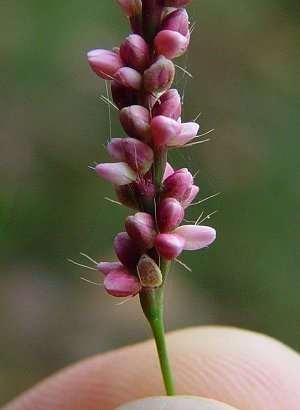
Reproductive axis of a greenhouse-grown Polygonum cespitosum plant showing cleistogamous flowers and developing achenes (Photo courtey of Sultan Lab, Wesleyan University).
So, there were a bunch of empirical threads in this paper that actually led to really useful insights about using this set of species as a model system—useful insights to other things that are going on, including the potential for rapid evolution of plasticity in an introduced range, and the way that that one component of fitness, which is the effect on propagule quality, can be an aspect of environmental influence on population success. But, you know, in terms of the field, this way of looking at fitness is no longer considered unconventional outside of population genetics. This still wouldn’t sit well in population genetics because the idea there is to assign a fitness value to a genotype. But I think many other aspects, let’s say evolutionary ecology, and certainly ecology and invasion biology, all of those fields now take the plasticity part of it on board. I don’t follow those fields enough to be able to see specific influence, but in general, the idea of phenotypic response to the environment is so much more commonplace now. Nobody would question it now. People know more about, say, behavioural plasticity and reproductive plasticity, and all of that is much more mainstream than it was when I was a graduate student.
But, you know, I think evolutionary biology is in a crisis, and that’s why there’s so much acrimony and debate around the Extended Evolutionary Synthesis. I think it’s really in a disciplinary crisis, because, even though the new ideas have been presented as a way of expanding old ideas, in fact, there are incompatibilities. If your goal or if your model requires assigning fitness value or phenotypic value to genetic variants, that is simply incompatible with what we know about molecular biology. You talk to molecular biologists, and they will say “you can’t talk about ‘the gene for something. That’s ridiculous. You can’t talk about the gene for this phenotypic state. That’s just ridiculous. That’s not how genes work.” Gene expression is what’s important. The gene’s sequence doesn’t have a fixed phenotypic identity. That’s just not how genes work. And it’s not a matter for debate. There’s no question about it. But that realization is simply not compatible with the framework of population genetics. And there’s no obvious solution, if we want to hold on to population genetics theory, and want hold on to the idea that the way to study evolution is to study genetic variants, and that all you need to know is which is the gene responsible. That’s just not compatible with a recognition that what matters is the process of development, the process of genotypic regulation and expression. I don’t know how those things are going to continue to be allied. In my career, they have diverged. That’s why I don’t publish in Evolution anymore. That’s why development is more of the right category for me. That’s eco-evo-devo for you. It’s not about categories.
HS: Earlier you spoke about how you became interested in plasticity because you saw it all around you in plants. I was wondering whether this is something that you’ve thought about, about how much of your view of the world comes from looking at the world through the lens of plants?
SS: I think that’s the right question to ask. I do think that every biologist is very much influenced by the organism they study. It is true for me, but it is true for everyone. It’s not that people who study animals are less that way. They’re just as much that way, right? People who study hydrozoans see things very differently than people who study lizards and people who study annual plants. I’m actually interacting now with someone who studies Ginkgo trees. And his way of thinking about organisms is all about these extremely ancient and very long-lived organisms, and my way of thinking about organisms is all about these rather short-lived organisms that are very rapidly evolving and whose bodies lack dead tissue. If you study trees, a lot of the body you study is dead, and that has its own functional significance. Those cells are doing a lot, they’re just not alive. So, yes, we are all very influenced by what we study. Initially, people would say things to me like, well, plants are very plastic, but that’s just plants. Now there are thousands and thousands of studies showing that animals are very plastic too. Animal phenotypes are expressed differently in different environmental conditions, even if not in the same ways as plants. Plants are organisms that change the number of their body parts. Well, tetrapods, not so much. The head number in tetrapods is very canalized! One head. You’re not going to see environmentally contingent expression for that trait. What you will see is environmentally contingent expression of all kinds of interesting traits at the level of tissues and cells, physiological systems and behaviour. How thick is the skin? How many red blood cells are present? I mean, there’s all kinds of modulation of the phenotype. It’s just not going to be in terms of the number of body parts. That’s part of studying a particular system, right, to know where to look for what’s going on. So, yes, what I study has been very much conditioned by plants. and annual plants in particular, in which the developmental responsiveness is so obvious because the number and size of body parts varies. And, the size of the body is hugely variable depending on the environment. The variation of those traits is specific to the organisms I study; not unique, but more obvious in those organisms than in some other organisms. But the phenomenon is absolutely characteristic of all living systems. I started out being very closed to studying DNA and studying at the molecular level, because I was convinced that what was interesting was not happening at that level. But now, over these decades that I’ve been working, all of the really mind blowing information about how biology works has come from molecular biology, right? Now we know about gene regulation and how extraordinarily complex and sensitive it is, and about epigenetics, the very thing that we were promised could never happen—that genes could be changed by the environment. Those two things are a complete revolution in how we understand the role of genes and the basis of phenotypes. But if you look for those things in evolutionary biology, they’re just not there. You can go to the NSF website and look at the description of the evolution program, and the word epigenetics is not there. I called those people up and ask: do you ever support work on epigenetics? One of the chairs of the program said, No, we really don’t do that. I mean, come on! These are the biggest new developments in biology, and they just look away.
Anyway, I’ve gone so far afield from your question. You asked me about viewing the world through the lens of plants. The answer is, yes, it has influenced me because it’s very easy to study this kind of response in plants. Operationally, it’s easy, and this is why I did it. Operationally, it’s easy because you can clone them and put them in different environments and measure their phenotypes. All of those steps are very straightforward in plants. It is much simpler than studying, you know, a bunch of rats. First of all, you can’t clone rats, so the whole experimental design is out the window. And second of all, putting them in different environments is very problematic. You can’t pull the environments apart as much and still keep them alive. And third of all, measuring their phenotypes is really hard, because you’re going to have to measure those tissue and physiological responses, and behavioural responses. That’s just more work. And that’s why the literature of plasticity and eco-devo is so rich for plants; experimentally, it’s so much more straightforward. One thing I love about the plants that I study is that I can look at so many aspects of the phenotype so easily. I can look at the physiological metabolic rates. I can do some of the tissue stuff. A lot of these growth traits are so straightforward to measure. That means I get a really good picture of many different dimensions of phenotype in these organisms. There’s a lot of good reasons to do this with plants, but the reason is not because it’s only true in plants. It’s just that plants are very good, straightforward systems for studying response, and in particular, for doing so very cleanly by holding the genotype constant. Originally, people would say things to me like, you know, this doesn’t really happen in anything else. Well, that’s not true. It happens in everything. There’s a lot of data now on the different ways that phenotypes are modulated in response to the environment in every living thing. And now we know why, because now we know that gene expression is modulated by the environment. So, of course, it’s going to be true of every organism. How would it not be? The things that are different, I think, are Bacteria and Archaea. Bacteria and Archaea seem to have a much shorter route between the genetic material and the phenotype, partly because they don’t have much phenotype. They have very tight constraints about their conditions for living, right? I think those organisms have a different relationship to the environment than eukaryotes do. I wouldn’t presume to comment much on it, except to say that, when I’ve talked to people who study bacteria, it seems more legitimate to assign a phenotype, or let’s say, a niche, to a genotype. And I think those organisms are genetically and functionally constrained in ways that eukaryotes are not. The individual eukaryote cell is such a complex system of response. Maybe that’s an important distinction with respect to plasticity, but not the distinction between plants and animals.
HS: Today, 23 years after it was published, what might be a reason for a student or young researcher to still read this paper? Would it be mainly for historical interest? Or, does it still talk to the kind of research that’s ongoing today?
SS: What would I say? That’s an interesting question. I am always struck by the fact that a lot of my older work is being cited a lot now. and that makes me think that it is still useful. This paper, for sure, could be useful to someone who’s thinking about these issues now. I think there is quite a long lag time in the field. When this paper was published it was very odd. That’s why I’d really like to see the citation statistics, because I have a feeling it sat there for 10 years before anybody cited it. A lot of my work is cited a lot now. And I’m like, “Why are you citing this 25 year old paper now?. There’s newer things!” But I think there’s quite a long lag in people catching up with the importance of thinking about response to the environment as the way organisms work. And, thinking about their adaptive capacities in that way. I think textbooks take a long time to catch up. There’s a long lag. People teach their courses the way they’ve taught them for decades. There are people still teaching 1990s biology, and that means students are graduating with 1990s biology in their head, and they have to catch up somehow. One way they catch up is reading papers that push them forward, and reading this paper I think would still push them forward to being more aware of how phenotypes are differently expressed, and what that means for fitness, and to not think about fitness in a kind of population genetics way.
So, I don’t know. I hadn’t looked at the paper in a long time. I still think it’s pretty good. I think the work was very carefully conceived and set up, and it’s still quite unusual to manipulate multifactorial environments like this. It was a lot of work. I still think it’s an interesting way to look at adaptive diversity among species. And, it’s an unusually good system, because the species belong to a monophyletic group, and they share all the important attributes of their life cycle and reproductive system. There were very few confounding factors for a comparative study. I think it’s quite a robust study, and I would guess that, if it is still cited, it is not as a historical document
HS: At the time when it was published, do you remember any responses or reactions you got to the paper?
SS: No, I don’t. That’s the thing! When you publish a certain kind of result, everybody jumps on it, right? That’s why papers are in Science, because they’re the kind of thing people are ready for. That just hasn’t been true for me, because I’ve always been working a little bit outside of what most other people have been doing at the time. It’s true now. There’s been a lot of change. For example, it’s true with the transgenerational stuff, such that, now, when I publish that stuff people grab it. If you publish something now on methylation, for example, people grab it because there’s a lot of interest in that. But I think the work that I published in the 1990s and up until maybe 2010 was really just outside of what people were looking for at that time. I think people who were really intellectually curious grabbed it. For example, I got invited by someone named Dominique Bergmann to contribute to a Current Opinion in Plant Biology special issue on development. She’s a molecular developmental biologist. That’s someone who’s really looking for new ideas.
HS: When did this happen?
SS: I think in 2008. I was very gratified to be asked to do this thing because it meant I was being taken seriously by the people studying development, even though I don’t study the genetic pathways that lead to developmental expression as most people studying development do. I think that’s really a tribute to Bergmann as a scientist, that she was open and interested in a way of thinking that was new or outside of that conventional field. My perspective at this point is that the way science operates is mostly by people pursuing questions that are kind of hanging in the air, and interpreting them in the ways that most people are interpreting them. When I met Anthony Bradshaw in 2005, he told me that no one cited his foundational 1965 paper on plasticity for years after it was published, because in that era evolutionary biologists were keen to study adaptive genetic differences between populations. And, for people who, for whatever reason, step outside of that, there can be a lag time before other people are interested or consider it relevant or that it is a different road to try to create a new way of thinking, or to emphasize different ideas or approaches. It takes luck to be able to do it. I think I’ve been very lucky. I’ve been lucky in part because the data have been just so interesting. It turned out to be a very good system to work with. That is luck, and that happens to certain scientists. The system that they study is a system that’s empirically, very rich. And I think I’ve been lucky in that.
HS: This is my final question. What does this paper mean to you personally? Would you count this as one of your favourite pieces of work?
SS: Oh, gosh.
HS: Or, if I were to ask it differently, does another piece of work come to your mind immediately, when I ask you which is your favourite?
SS: I’m very fond of one of my thesis papers, actually. That’s a long time ago. The one on response to light. I mean, what is it that makes one’s paper a favourite? I don’t know. I mean, that’s a tough one. I wouldn’t have picked this paper as one of my favourites, but I quite liked it when I reread it, because I recognize in it the things that I think have made my experimental work of high quality. The attention to the environmental measurements in the field, the careful attention to environmental treatments in in lab, which is really unheard of. You read papers about people doing experiments in their lab or in their greenhouse, and they’re like, we used high and low light. Nobody goes out and actually measures how much light is being received. I aimed to really push on these aspects of quality and that’s what I see when I reread it, and that I find gratifying. It’s like, that was good work. I will stand behind this work. That’s maybe something that is nice to see when you revisit something from a long time ago. The papers that I really love, I guess, are things that showed something surprising. For example, some of the transgenerational work. There’s a couple of papers that aren’t very well cited that I think will be one day, because they show how, surprisingly, the plant can send signals from its own environmental experience to its offspring, creating a kind of transgenerational memory of stress in a way that changes what the offspring do. That’s an aspect of adaptive diversity, if you like, that is hard to study. It’s very little studied, except that it’s confounded in a lot of experiments, because researchers generally don’t know what the parent environment was. When we study something, we say we’re studying a genotype, but we’re studying a seed or an egg, and inside that entity is this kind of environmental history that we can’t take out. I’m very interested in those results, and in the papers that show surprising things there. I guess, maybe, some of those are my favourite now.
HS: What about the paper from your PhD? Why do you like that one?
SS: The data are great. If you grow plants in high and low light, the differences are so dramatic that you just get beautiful data. It’s also a comparatively easy kind of experiment to set up, because you just create different light environments. You set them up, and there they are. They don’t change. It’s much easier than maintaining, say, different watering treatments or different nutrient levels, which you have to maintain as the plants develop. I worked so hard on that experiment, and I really believe it was done very carefully. And, the data are really clear. That was my first experience of believing that I was doing really good quality science. For me, starting out, and not really having empirical training, that was a big bridge to cross. I think it was an important step to do work that I felt that confident about. I sound very confident now, but, of course, I’ve been doing it for a long time!
0 Comments